VIG in Historic Window Applications

How it preserves original character while dramatically improving performance.

Vacuum Insulated Glass is the only glazing thin enough to preserve the geometry that defines a historic window — while delivering thermal performance that exceeds modern code.

Request a Quote See How It Works
Why it matters

What People Respond to in Historic Windows (Even If They Can't Explain It)

To understand why Vacuum Insulated Glass (VIG) is often the only viable option for true historic replication, it's important to first understand what gives a 150-year-old window its distinctive character.

Most people don't think about offsets, profiles, or shadow lines. They simply recognize that historic windows feel right. There is depth, weight, and a sense that the window is part of the wall — not just applied to it. Light interacts with the edges, profiles cast shadow, and the glass is positioned in a way that gives the entire opening dimension.

These are small details, but together they define the character of the window. When they are altered, the window no longer reads as original.

This is also why Historic Preservation Commissions often reject standard replacement windows. The issue is not simply appearance in a general sense — it is the loss of very specific geometric relationships.

Those relationships are not arbitrary. They are remarkably consistent across historic construction.

The geometry

The Geometry of Historic Windows

Annotated cross-section of a historic wood window jamb showing 5-5/8 inch wall depth, 7/8 inch blind stop, 1-3/8 inch sash, and 1/8 inch glass set 3/8 inch from the interior and exterior planes
The layered dimensions of a historic jamb — small offsets that together create the depth, shadow, and proportion that define the original window.

From roughly the mid-19th century forward, building methods became standardized, and window construction followed. Wall thickness — typically around 5-1/2" — drove a predictable set of dimensions and offsets that still define historic windows today.

Working from exterior to interior, the glass is reached through a series of layered steps:

  • Exterior casing or brick mold — typically 3/4" to 1-1/4" or greater, establishing the outermost depth and helping retain the assembly.
  • Blind stop — typically 7/8", forming the outer track for the upper sash. One of the most consistent dimensions in historic construction, sized to match the original sheathing.
  • Glazing layer — with traditional sash construction (typically 1-3/8" thick with a centered tenon), roughly 1/8" is occupied by glass and 3/8" by the putty glazing profile.
  • Glass — typically 1/8" thick.
  • Interior sash molding profile — always matches the muntin profile, typically around 7/8", reinforcing depth and visual continuity.
  • Parting stop — creates the next step before repeating the glazing/glass relationship for the lower sash.
  • Interior profile — again at 7/8".
  • Interior stop — typically 1" to 1-1/4", completing the assembly. Generally less critical visually.

Individually, none of these dimensions seems significant. Together, they create the depth, proportion, and shadow that define a historic window.

Most people cannot identify these elements, but they recognize immediately when they are missing — and once altered, they cannot be recovered.

The solution

How VIG Preserves These Relationships

Vacuum Insulated Glass works because it allows these relationships to remain largely intact.

A typical historic single-pane unit uses glass approximately 1/8" thick. A VIG unit is typically around 1/4" to 3/8". That increase is minimal enough to be absorbed within the existing system without fundamentally altering the geometry.

In practice, the difference is managed by making the sash slightly thicker — on the order of 1/8" — and making minor adjustments to less critical elements such as the interior stop. The key dimensions — the offsets, profiles, and layered progression to the glass — remain intact.

Cross section of a Heirloom VIG unit set in a historic sash, showing the two glass lites, the 0.2 mm vacuum gap, micro spacers, and how the assembly preserves the original sash thickness, glazing profile, and interior/exterior offsets
VIG fits within historic sash geometry — preserving the original offsets, profiles, and layered depth that define the window.

What is gained is significant. Thermal performance improves dramatically — far exceeding even triple-pane insulated glass — while modern weatherstripping eliminates air infiltration without introducing visible changes.

The result is not a compromise, but a preservation of original design with modern performance layered in.

Unacceptable Option 1

Conventional Insulated Glass (IG)

At first glance, insulated glass appears to be the logical upgrade. Two panes of glass, sealed together with an air or gas-filled cavity, deliver improved thermal performance. It's the standard solution in modern construction.

But in a historic window, IG introduces a fundamental conflict:

It cannot physically fit within traditional sash geometry without altering it.

To accommodate IG, manufacturers are forced into a series of compromises:

  • Increasing overall sash thickness
  • Widening muntins to conceal spacers and edge seals
  • Reducing glass setback depth
  • Simplifying or flattening profiles
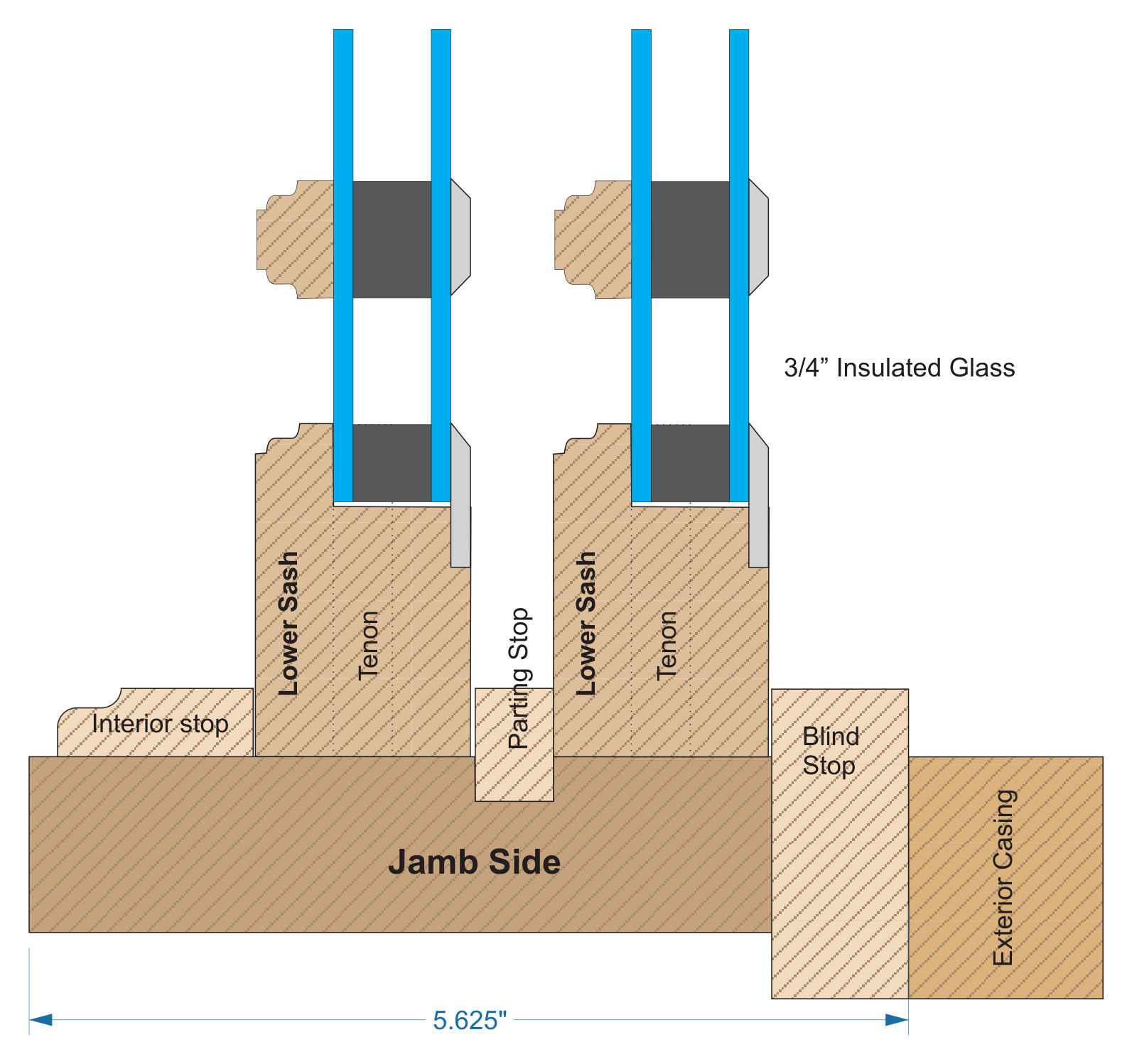
Cross section of a 1-3/8 inch historic-style sash forced to accept a 3/4 inch insulated glass unit, showing the thickened glazing assembly, reduced glass setback, and altered tenon geometry compared with the original single-pane window
Conventional insulated glass forces thicker sash profiles and wider muntins, altering the historic window geometry that defines the original character.

Individually, these changes may seem minor. Collectively, they redefine the window. What you end up with is familiar: a window that matches the original layout — but not the original character. It lacks depth. It lacks shadow. It lacks the dimensional hierarchy that makes historic windows feel integrated into the structure.

This is why IG-based replacements are so often rejected by Historic Preservation Commissions — or approved only as a compromise. And even when approved, the visual result rarely holds up.

A common attempt

Why True Divided Lites (TDL) Don't Solve the Problem

A common attempt to correct IG's compromises is to use true divided lites. The thinking is straightforward: if each pane is individually glazed, the window must be more authentic.

But the limitation isn't the concept of divided lites — it's the glass unit itself. Even when split into smaller sections, IG still requires:

  • Spacer systems
  • Edge seals
  • Structural thickness

Those requirements force muntins to grow beyond historic proportions. Instead of delicate members, you get muntins that are thick, heavy, and visibly modern. The construction method may be traditional, but the scale is not.

And scale is what the eye reads first.

Simulated divided lites

The SDL Compromise — and Its Limits

Simulated divided lites (SDL) attempt to replicate the look of TDL by applying muntin bars to the surface of a single insulated glass unit. This avoids some structural constraints, but introduces new visual ones.

To conceal the unattractive back sides of the muntins that would be visible with SDL on IG units, internal grids must be used inside the unit — and they themselves are blatantly obvious, unattractive, and antithetical to historic accuracy.

Beyond that:

  • Surface-applied bars lack true depth
  • Light does not interact with them the same way
  • Shadow lines are diminished or lost

From a distance, SDL can pass. Up close — and especially in natural light — they fail to replicate the original.

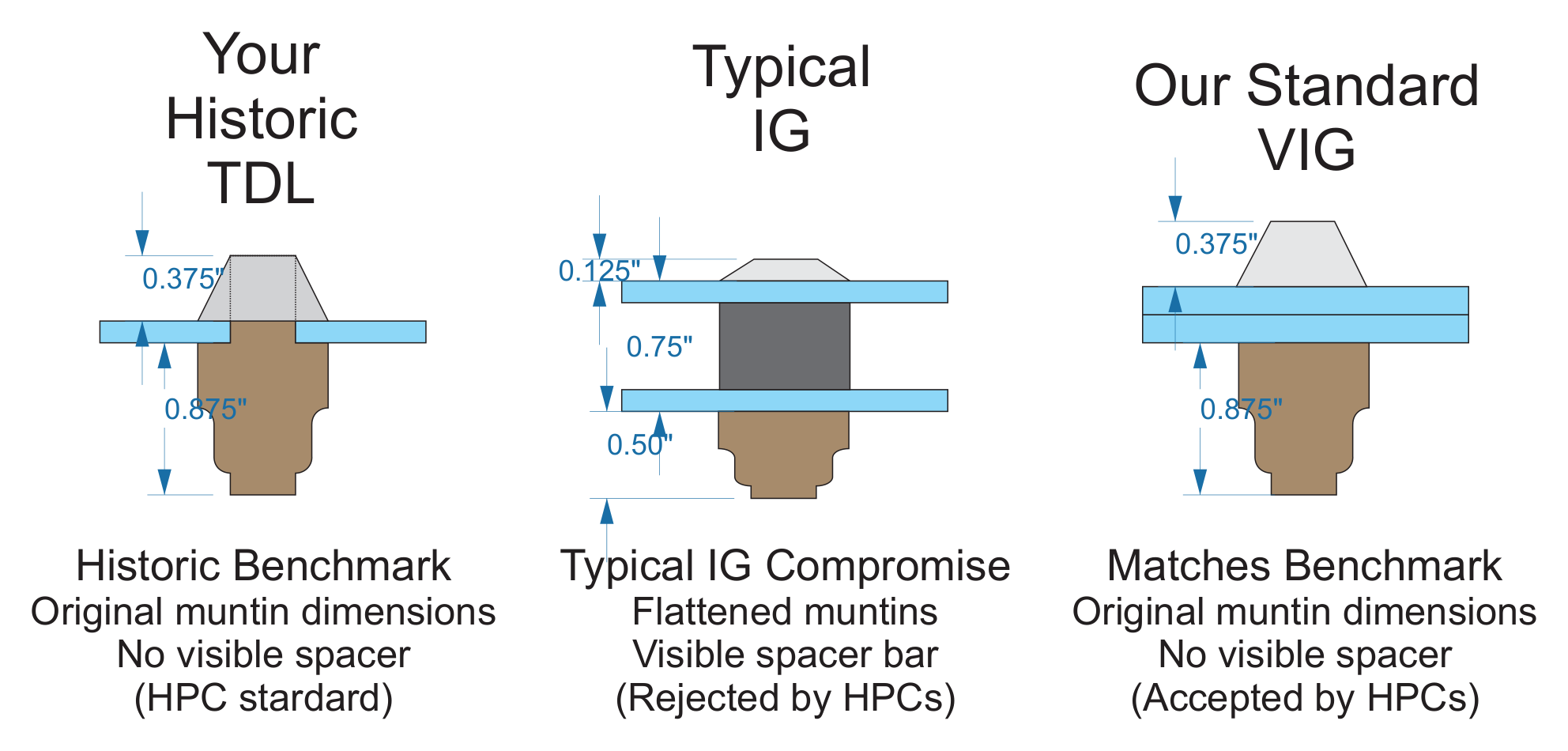
Three muntin profiles drawn side by side: a historic true divided lite with a 0.375 inch cladding over a 0.875 inch muntin, a typical IG muntin flattened to 0.125 inch with a visible 0.75 inch spacer bar and 0.50 inch lower section, and a Heirloom VIG muntin matching the historic 0.375 inch over 0.875 inch benchmark with no visible spacer
TDL benchmark on the left, typical IG compromise in the middle, Heirloom VIG on the right — VIG matches the historic muntin geometry that IG cannot.

SDL applied to VIG is the only solution to the challenge.

Because the two lites of VIG are separated by only 0.2 mm, the two lites read as one. It's practically impossible to determine it's two lites, even when holding a piece of VIG and looking closely.

When muntins are applied to VIG, the unit looks identical to TDL. HPC review architects have stated they cannot discern a VIG SDL from a TDL. Restoration professionals have inspected VIG SDL units and mistaken them for TDL. That is why, after inspection, HPCs have universally approved the VIG/SDL solution.

Unacceptable Option 2

Storm Windows

Storm windows attempt to solve a thermal problem with a geometry that fundamentally cannot perform.

While storm windows are often the first solution considered when attempting to improve the thermal performance of historic windows, they present several fundamental limitations.

The first issue: performance.

Storm windows rely on an air space between the storm and the primary sash. While this does provide some insulation, it is inherently limited by physics. There is a point at which increasing the air space no longer improves performance. Instead, convection begins to occur — a phenomenon often referred to as thermal roll.

This is why modern insulated glass units rarely exceed spacer depths of approximately 3/4", even when more space is available.

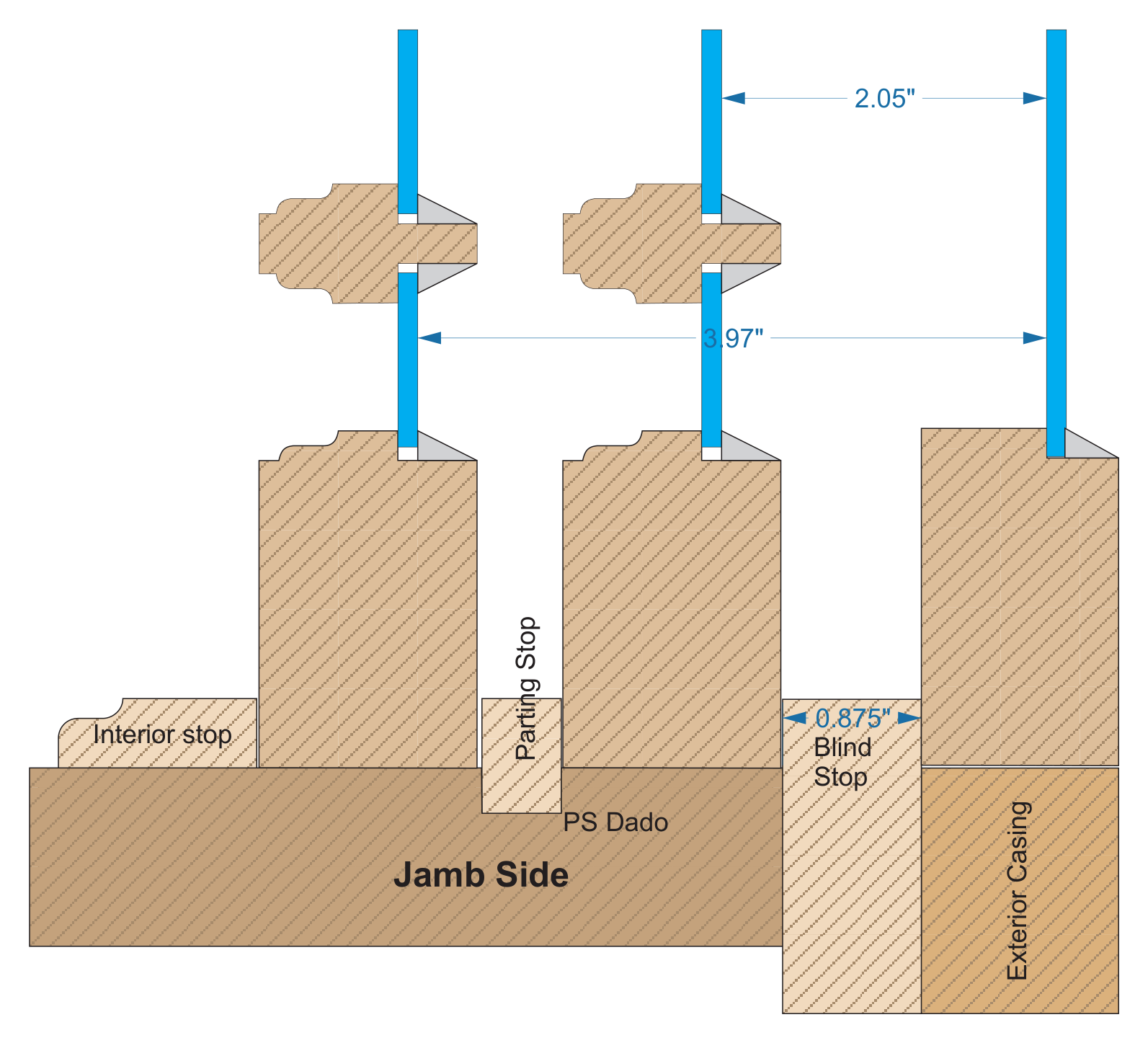
In a typical historic installation, the distance between the storm lite and the primary sash is approximately 2" to the upper sash and nearly 4" to the lower sash. At those distances, the space is no longer "dead air." It becomes an active chamber where air circulates freely. The system is no longer insulating — it is exchanging heat internally.

Cross section of a historic window with an exterior storm panel, dimensioned at 2.05 inches between the storm and the upper sash and 3.97 inches between the storm and the lower sash, illustrating the deep cavity in which thermal roll occurs
A 2"–4" cavity is too deep to insulate — air circulates freely between the storm and the primary sash, exchanging heat instead of trapping it.

This is the critical flaw in storm window performance. Even with ideal installation, storm windows typically provide less than a 50% improvement in thermal efficiency.

The fundamental tradeoff

Storm Windows Are Forced Into a Compromise That Cannot Be Resolved

If the system is tight
Performance up,
moisture trapped
  • Warm interior air enters the cavity
  • Condenses on colder glass
  • Fogging, water accumulation, and potential deterioration of the primary window
If the system is vented or loose
Moisture out,
performance lost
  • Air movement disrupts the insulating layer
  • System behaves like a single-pane window

A storm window cannot simultaneously maintain a sealed, high-performance air layer and safely manage moisture within that same cavity. There is no stable middle ground — and this is not an installation issue, it is a limitation of the system itself.

Complexity and maintenance

Storm windows introduce an additional layer to the system:

  • Another unit to maintain
  • Another surface to clean
  • Additional hardware to manage

If ventilation is desired, storms must be removed and stored, creating inconvenience and risk of damage — before even considering the added cost.

Visual impact

After establishing the importance of depth, proportion, and shadow in defining historic character, storm windows directly undermine those qualities. By placing an additional layer of glass toward the exterior, they flatten the entire assembly. The depth and dimensional layering of the primary window are visually compressed or lost altogether.

The result is a surface that reads as flat and visually disconnected from the wall — precisely the condition historic windows avoid.

Historic appropriateness

Storm windows are not historically appropriate in most applications. They only became common in the early 20th century and were not part of earlier construction. Prior to their adoption, shutters were the primary method of protecting window openings.

Side-by-side

Performance Reality

Lower U-Factor = better  ·  Higher R-Value = better

System What's Happening Typical Performance Outcome
Single-pane historic window Direct heat transfer ~U-1.1 to 1.25 (R ~0.8–0.9) Poor thermal performance
Storm + single-pane 2"–4" air gap with convection (thermal roll) ~U-0.30–0.70* Moderate improvement, but unstable in practice
Double-pane IG Sealed air space (no convection) ~U-0.25–0.50 (R ~2–4) Better performance, but forces geometry changes
Triple-pane IG Multiple sealed cavities ~U-0.15 (R ~6–7) High performance, but far too thick for historic replication
Vacuum Insulated Glass (VIG) No air, no convection ~U-0.05–0.14 (R ~7–20) Maximum performance with no geometric compromise

*Performance depends heavily on airtightness; tighter systems improve insulation but increase condensation risk.

The bottom line

If the Goal Is a Window That Is…

  • Indistinguishable from original
  • Acceptable in historic applications
  • High-performing by modern standards

There is only one viable solution.

Not modified IG. Not storm windows.

Vacuum Insulated Glass.

Ready to discuss your project?

We build historically accurate wood windows with VIG for restoration and historically styled new construction. Tell us about your project and we'll put together a quote.

Request a Quote
// Array of keywords to block